
Black Panther Party: How the Organization Actually Operated
Behind the slogans: how the Panthers organized, monitored police, built social programs, and triggered a coordinated government response.
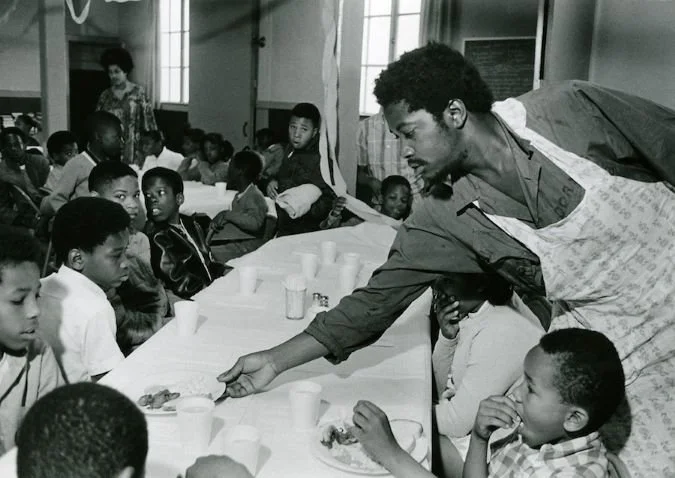
Charles Bursey hands a plate of food to a child as part of the Black Panther Party's free breakfast program. Photo courtesy of Pirkle Jones and Ruth-Marion Baruch
The Black Panther Party is often reduced to images—leather jackets, raised fists, armed patrols. In practice, it operated as a tightly structured political organization that combined community programs, legal police monitoring, and centralized leadership. Its growth—and the government response it provoked—shaped how the U.S. now handles policing oversight, surveillance, and political dissent.
This explainer describes how the organization functioned in real terms and how public institutions reacted. It is an educational analysis of systems and state response, not an endorsement of tactics or ideology.
-
Founded in Oakland in 1966 by Huey P. Newton and Bobby Seale, the Black Panther Party was both a political organization and a service provider. It combined explicit ideological commitments with practical operations: patrols observing police behavior, community-run social programs, and political education.
The Panthers were not a single-issue group. Their platform addressed policing, poverty, housing, education, healthcare, and political representation. What distinguished them was not just what they believed, but how they organized to act on those beliefs.
-
The Panthers functioned through local chapters tied to a national leadership structure. Chapters had autonomy over daily operations but followed centralized rules, messaging, and discipline.
One of the Panthers’ most visible activities was armed police monitoring. At the time, California law allowed the open carry of loaded firearms. Panthers used this legality to observe police stops, document encounters, and verbally assert constitutional rights. These patrols were structured, rule-bound, and intended to create a public record of police conduct.
Alongside patrols, chapters built what they called “survival programs.” These included free breakfast programs for children, health clinics, sickle-cell screening, legal aid, clothing distribution, tutoring, and political education. These programs relied on volunteers, donations, and partnerships, and operated as parallel institutions where public services were absent or inaccessible.
As the organization expanded, internal strain increased. Disagreements over ideology, leadership authority, and whether to prioritize community programs or confrontational tactics created fractures. These internal dynamics mattered, but they unfolded alongside increasing external pressure.
-
Strategic direction came from central leadership, including Newton, Seale, and the Party’s Central Committee. National leadership set ideology, approved messaging, and controlled key publications, especially The Black Panther newspaper, which functioned as both an organizing tool and a unifying internal voice.
Local chapter leaders managed operations: patrol routes, program logistics, alliances, and recruitment. Figures such as Fred Hampton and Elaine Brown shaped regional strategy and built coalitions with labor groups, student organizations, and antiwar movements.
Outside the organization, public institutions exercised decisive influence. Police departments shaped daily risk through arrests and raids. Prosecutors and courts determined legal exposure. Federal agencies—especially the FBI—coordinated surveillance and disruption efforts that directly affected the Party’s capacity to operate.
-
Government response was not passive or fragmented. Local, state, and federal institutions treated the Panthers as a coordinated political threat.
The FBI’s COINTELPRO program targeted the organization through surveillance, infiltration, disinformation, and coordination with local law enforcement. Internal communications were disrupted. Leadership was criminally charged. Raids, arrests, and, in some cases, lethal encounters followed.
Media coverage often emphasized confrontation while minimizing community programs, shaping public perception and political support. Legal pressure, combined with internal conflict and sustained surveillance, contributed to the Party’s decline by the mid-1970s.
This response became a reference point for later debates over the limits of lawful surveillance, political policing, and civil liberties.
-
Several systems now taken for granted trace back to this period. School breakfast programs expanded nationally after Panther programs demonstrated unmet need. Community health screening gained visibility. Legal observation and civilian oversight models drew from earlier police monitoring practices.
At the same time, COINTELPRO remains central to discussions about government power, protest movements, and the boundaries of lawful state action. The Panthers’ experience illustrates how political organizations, public services, and enforcement institutions interact under pressure.
-
These sources document how the Black Panther Party organized, how law enforcement and federal agencies responded, and how those interactions shaped later debates about surveillance, policing, and civil liberties.
Federal Bureau of Investigation. COINTELPRO Records (1967–1971)
Stanford University Libraries. Huey P. Newton Papers (1954–1974)
Smithsonian National Museum of African American History and Culture. Black Panther Party and the Free Breakfast Program (2018)
https://nmaahc.si.edu/explore/stories/free-breakfast-program
Encyclopaedia Britannica. Black Panther Party (2024)
University of California Press. Black Against Empire (2013)
https://www.ucpress.edu/book/9780520272149/black-against-empire
PBS Independent Lens. Black Panthers: Vanguard of the Revolution (2015)
https://www.pbs.org/independentlens/documentaries/the-black-panthers-vanguard-of-the-revolution/